
Blog Fullwidth
Blues Guitar Lesson: Killer Blues Licks with These 3 Tricks!

JOIN THOUSAND OF OTHER GUITAR PLAYERS IN MY FREE ONLINE COMMUNITY… AND GRAB A POWERPACK OF EXCLUSIVE ‘MEMBERS ONLY’ LESSONS!
In this lesson you’ll learn 3 simple tricks you can use for killer blues licks and better blues guitar solos. Let’s dive in!
0:40 Everything in this blues guitar lesson is shown in the key of G and uses these blues scale patterns shown. All the blues licks and ideas will work great over a 12 bar blues in the key of G but make sure you move it to other keys as well.
1:17 Killer Blues Trick 1
If there’s one must know string bend in blues guitar…it’s this! It’s up at the 8th fret in the key of G and comes from the top part of the sliding blues scale. You’ll recognise it from the kind of licks I play here.
It’s versatile and works at lots of different points in the 12 bar blues.
3:08 Practice using this bend and it will start to come out naturally in your blues licks and solos.
3:18 Killer Blues Trick 2
This awesome little blues slide will give your solos some ‘grease’! It comes from the 1st pattern of the G blues scale. I use my 3rd finger to play it. Find ways to ‘get in’ to the lick and ways to ‘get out’ of it and practice mixing it in amongst all the blues licks and tricks you do already.
4:54 Killer Blues Trick 3
Essential bending technique for awesome blues bends! This will make a huge difference to your blues licks and solos because we use bends all the time when we play blues solos. Use your picking hand to ‘cut off’ the bend before you release it rather than getting a ‘let down’ sound all the time (even when you don’t want it).
Also experiment with letting the bend so you do hear it. A mixture of these different bending techniques will make your blues solos and blues licks more interesting.
Have fun!
THEN JOIN THOUSAND OF OTHER GUITAR PLAYERS IN MY FREE ONLINE COMMUNITY… AND GRAB A POWERPACK OF EXCLUSIVE ‘MEMBERS ONLY’ LESSONS!
Read More
Double Stops Moves: Essential Technique for Killer Rock Licks!
Learn some killer rock double stops moves and slip them into your solos. Create new licks with this awesome technique like the Rock guitar masters, such as Slash, Angus Young, Zakk Wylde and others!
Today I’ll show you:
- Double Stop lick 1. Using the common double stop we hear on the top 2 strings. It’s using a common bend and double stop combination before finishing with a little blues scale run.
- Double Stop Lick 2. This one is one of Angus Young’s favorites. You can find it in a lot of his solos. You’ll notice that it’s using a note which isn’t in the blues scale shape but normally works great when we add it in.
- Double Stop Lick 3. This one is very used by Slash, Zakk Wylde and a lot of other great guitar players. Watch the fingering on this and use whichever option seems best to you.
- Double Stop Lick 4. It takes a little practice and strength to get this bend happening but it’s worth the effort. Notice how I’m re-picking the bend whilst holding it up and also damping it off to stop it ringing out too much.
With these double stop moves, you can experiment and create some new cool licks. They will help you to power up your solos and make them sound cooler!
GRAB YOUR FREE ROCK JAM PACK INCLUDING THE LESSON BACKING TRACK, ESSENTIAL SCALES (YOU NEED TO KNOW!), LICK LESSONS AND MORE!
Create killer rock guitar licks with these essential double stops moves! Perfect for high energy rock and metal solos. This double stops guitar lesson will show you exactly how to do this using double stops from Slash, Angus Young, Michael Schenker, Zakk Wylde and others!
Double Stops moves Guitar Lesson for Killer Rock Guitar Licks!
Here’s what you learn in this guitar lesson:
00:07 Hear me jamming using some of the double stops I’ll show you in this lessons.
0:35 Double stops – what are they? A double stop is simply two notes played together on the guitar, kind of like a ‘mini chord’. They give a chordal sound to your rock solos and break up the sound of ‘single note’ licks and runs to create cool contrast.
1:00 Let’s look at a set of essential double stops and a sample lick from each one to give you some ideas for double stop licks of your own.
1:15 Here’s a reminder of how to play the A blues scales down at the 5th fret.
1:32 Double stop lick 1. Using the common double stop we hear on the top 2 strings. It’s using a common bend and double stop combination before finishing with a little blues scale run. A favourite of most of the great players from Chuck Berry to Vai!
3:48 Double Stop Lick 2 – This is a favourite of Angus Young! It’s using a note which isn’t in the blues scale shape but normally works great when we add it in. Try throwing this into your solos…it’s got a wicked punchy sound to it.
5:55 Double Stop Lick 3. Here’s a cool double stop bend which will be an awesome addition to your lick library. Watch the fingering on this and use whichever option seems best to you. Once you get used to using this double stop try digging in to create a gritty, aggressive sound to it.
6:48 Double Stop Lick 4. Check out this common double stop bend. It takes a little practice and strength to get this bend happening but it’s worth the effort. Notice how I’m re-picking the bend whilst holding it up and also damping it off to stop it ringing out too much.
9:20 Double Stop Lesson Tips
Learning these licks is a good start but make sure you take each double stop out and experiment with jamming out some of your own ideas. This is essential! Also notice where the double stops are found in the scale so you can easily find them when you move the scale around to different keys.
Have fun with ’em and see you next time!
GRAB YOUR FREE ROCK JAM PACK INCLUDING THE LESSON BACKING TRACK, ESSENTIAL SCALES (YOU NEED TO KNOW!), LICK LESSONS AND MORE!
Read More
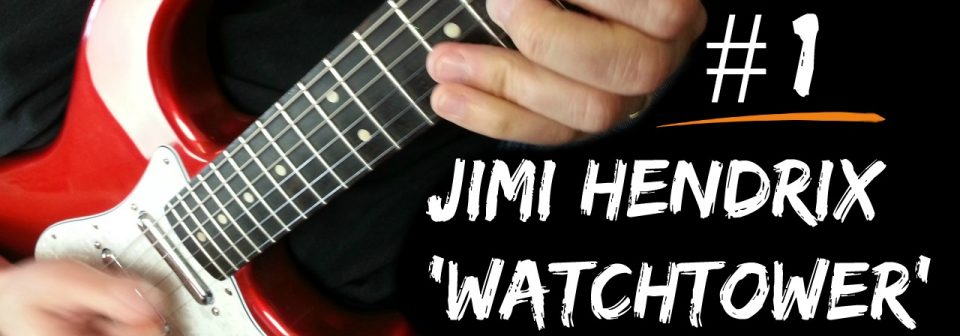
Classic Jimi Hendrix Style Lick: ‘Watchtower’
Jimi Hendrix Style Lick: Watchtower
Learn a classic Jimi Hendrix style guitar lick similar to what Hendrix plays at the end of his classic ‘All Along the Watchtower’ solo. This lick uses many classic Jimi Hendrix style moves and is a cool addition to your guitar lick bag. So let’s jump in and check out the this Jimi Hendrix lick!
0:15 Here’s the Jimi Hendrix lick you’ll learn in this guitar lesson.
0:29 The lick comes from the C# blues scale played up around the 9th fret. Here’s the scale pattern Jimi Hendrix is using for this particular lick.
0:45 Jimi Hendrix used to tune his guitar down one fret remember! So if you hear this lick played on the recording to ‘All Along the Watchtower’ it’ll sound 1 fret lower than it does here (because I’m in standard tuning!)
0:55 Jimi Hendrix Lick chunk 1. Here’s how to play the first part of the lick.
1:30 Jimi Hendrix lick chunk 2. Here’s how to play the second part of this guitar lick. Notice all the cool bends…take ’em and make sure you’re using these in your own playing.
2:09 Jimi Hendrix lick chunk 3. Here’s how to play the next part of this guitar lick. Notice the cool blues scale runs here. Take these and experiment with making up your own guitar licks using these as a starting point!
2:33 Here’s the complete lick played slowly.
2:43 Here it is played over the backing track.
Experiment with this lick to see how you can make it work in your playing and remember the most important thing is to create variations of your own.
Have fun!
Read More
Learn This Classic Jimi Hendrix Double Stop Lick!
Jimi Hendrix Style Double Stop Lick: ‘Double Stopper’
Lesson 2 in my Jimi Hendrix guitar licks series. This is similar to what Jimi Hendrix plays at the start of his classic ‘All Along the Watchtower’ solo. This lick uses trademark Jimi Hendrix double stops and is a cool addition to your guitar lick bag. So let’s jump in and check out the this Jimi Hendrix lick!
0:15 Here’s the Jimi Hendrix lick you’ll learn in this guitar lesson.
0:29 The lick comes from the C# blues scale played up around the 9th fret. Here’s the scale pattern Jimi Hendrix is using for this particular lick.
0:45 Jimi Hendrix used to tune his guitar down one fret remember! So if you hear this lick played on the recording to ‘All Along the Watchtower’ it’ll sound 1 fret lower than it does here (because I’m in standard tuning!)
0:59 Jimi Hendrix Lick chunk 1. Here’s how to play the first set of double stops at the start of the lick.
1:52 Jimi Hendrix lick chunk 2. Here’s how to play the second part of this guitar lick. Notice all the cool double stop bends…take ’em and make sure you’re using these in your own playing.
2:09 Jimi Hendrix lick chunk 3. Here’s how to play the next part of this guitar lick. More double stops! Take these and experiment with making up your own guitar licks using these as a starting point
2:28 Here’s the complete lick played slowly.
2:51 Here’s the Jimi Hendrix lick played over the backing track now.
Read More
Learn This Jimi Hendrix ‘Hey Joe’ Style Rock Lick!
Jimi Hendrix Lick -‘Hey Joe’ style
Welcome back to my Jimi Hendrix guitar lick series and it’s time for another Jimi Hendrix licks. This time it’s a lick similar to what Jimi plays at the start of his solo on ‘Hey Joe’. This lick uses trademark Jimi Hendrix blues style string bends and slides. So let’s jump in and check out the this Jimi Hendrix lick!
0:13 Here’s the Jimi Hendrix lick you’ll learn in this guitar lesson.
0:29 The lick comes from the E minor pentatonic scale played up around the 12th fret. Here’s the scale pattern Jimi Hendrix is using for this particular lick.
0:39 Jimi Hendrix Lick chunk 1. Here’s how to play the firstpart of the lick. It’s using some soaring string bends from inside the E minor pentatonic scale.
1:18 Jimi Hendrix lick chunk 2. More Hendrix style string bending ideas. Check out these bends…take ’em and make sure you’re using these in your own playing.
2:09 Jimi Hendrix Lick chunk 1 played slowly with chunk 2.
2:20 Jimi Hendrix lick chunk 3. Just more bluesy phrasing here with slides, vibrato and punchy phrasing. T
3:00 Here’s the complete lick played slowly.
3:14 Here’s the Jimi Hendrix lick played over the backing track now.
Hope you enjoyed this lesson. Remember to experiment to see how you can ‘twist’ this lick into some cool licks of your own.
Have fun!
Read More

Jimi Hendrix Lick: Learn a Killer ‘Hey Joe’ Style Hendrix Lick!
Jimi Hendrix Licks – Killer Jimi Hendrix Lick Lesson!
Learn a classic Jimi hendrix style guitar lick similar to what Hendrix plays at the end of his classic ‘Hey Joe’ solo. This lick uses many classic Jimi Hendrix style moves and is a cool addition to your guitar lick bag. So let’s jump in and check out the this Jimi Hendrix lick!
0:12 Here’s the Jimi Hendrix lick you’ll learn in this guitar lesson.
0:24 The lick comes from the E minor pentatonic scale played up around the 12th fret. Here’s the scale pattern Jimi Hendrix is using for this particular lick.
Jimi Hendrix used to tune his guitar down one fret remember! So if you hear this lick played on the recording to ‘Hey Joe’ it’ll sound 1 fret lower than it does here (because I’m in standard tuning!)
0:34 Jimi Hendrix Licks – chunk 1. Here’s how to play the first part of the lick.
1:07 Jimi Hendrix Licks- chunk 2. Here’s how to play the second part of this guitar lick. Notice all the cool bends…take ’em and make sure you’re using these in your own playing.
1:50 Jimi Hendrix Licks- chunk 3. Here’s how to play the next part of this guitar lick. Remember why we learn guitar licks: to gather together ‘structures’ and ideas to use for making up our own licks and solos! Take these and experiment with making up your own guitar licks using these as a starting point!
2:25 Here’s the complete lick played slowly.
2:40 Here’s the Jimi Hendrix lick played over the backing track now.
As always take this and see how you can use it to make up cool licks of your own. Have fun and catch you next time!
Read More
Bending Vibrato Guitar Lesson: How Do I Vibrato String Bends?
Vibrato can sound awesome on string bends and it’s a sound we hear all the killer rock and blues guitar players use in their solos!
But how can you do it without the bend just, er…fizzling out completely when you vibrato it?
In this lesson I’ll show you
- The right way to add vibrato to a bend (for a big, exciting and punchy sound!)
- The No.1 problem guitarists have with this technique (and how you can fix it…easily!)
- 3 things you need to make your vibrato go from ‘so so’ to awesome !
So dive in and find out how this technique can literally transform the sound of your licks and solos!
JOIN THOUSANDS OF OTHER GUITAR PLAYERS IN MY FREE ONLINE COMMUNITY… AND GRAB A POWERPACK OF EXCLUSIVE ‘MEMBERS ONLY’ LESSONS!
Bending Vibrato Guitar Lesson – How Do I Add Vibrato To String Bends?
0:23 Hear a demo of what vibrato sounds like with string bends. Notice how it makes bends so much more expressive and energetic!
0:48 Bending Technique and hand Position
If you’re getting a poor sounding string bend to start with…then no amount of vibrato will get it sounding good! Here we look at some key pointers for solid bending technique. I suggest putting your thumb firmly over the top of the neck when you bend and make sure you use the next door fingers to help push the string. This makes it easier to move it as well as providing much needed stability and strength.
1:41 Adding Vibrato to a Bend.
To add vibrato to a bend you basically let the bend down a fraction then bend it back up to pitch. This takes a little control to get sounding good! Only let the string down a very small amount before bending it back up again.
2:05 Vibrato and Bending (Tips for Success!)
So that’s the mechanics of how it’s done. Now let’s look at some crucial tips you need to know about to get your vibrato on your bends sounding good.
2:15 Vibrato Tip 1- Make your vibrato sound rhythmic.
Give your vibrato a rhythmic ‘pulse’ so it sounds musical, controlled and polished.
2:45 Vibrato Tip 2 – Bend the String Back to Pitch
Out of tune vibrato is not good! After you let the bend down make sure you bend it all the way back up again. If it’s ‘in between’ then it’ll sound like an out of tune bend…not good.
3:14 Vibrato Tip 3 – Even ‘Let Downs’
Try to let the string bend down the same amount each time. This will make the tone and pitch of your bending vibrato consistent and smooth. If you’re doing this and making your vibrato rhythmic at the same time then you’re on your way to getting great vibrato and string bending technique.
3:50 Vibrato Tip 4 – ‘Pin’ the String
As you bend and vibrato you need to keep pressing the string ‘into’ the fingerboard of your guitar. If you release the pressure here then you’ll lose the sound and note. So it’s essential to keep a strong grip on the string even though you’re pushing it up and down.
4:40 Bending Vibrato Practice Exercise
One of the best ways to practice your bending vibrato is to take a common scale like the minor pentatonic and practice adding vibrato to the most often used bends from the scale. I demo this using the A minor pentatonic scale.
THEN JOIN THOUSANDS OF OTHER GUITAR PLAYERS IN MY FREE ONLINE COMMUNITY… AND GRAB A POWERPACK OF EXCLUSIVE ‘MEMBERS ONLY’ LESSONS!
Read More
How to Play Pinch Harmonics on Guitar
Would you like to master pinch harmonics technique and give your solos that magic ‘pro’ touch?
Stay tuned to discover what they are,how to nail the technique and how to make them sound awesome for powerhouse rock and metal solos!
In this lesson you’ll discover
- What are pinch harmonics?
- Secrets for where to hit the string to get them sounding full, fat and awesome!
- Powerful exercises to get you nailing them every time!
- It’s what you do with them that counts! Discover awesome tips to bring them to life (and get them sounding like your heroes.
After watching this lesson, you’ll be able to master this awesome technique and get your harmonics sounding as cool as Steve Vai, Eddie Van Halen, Zakk Wilde, Billy Gibbons and many more.
JOIN THOUSANDS OF OTHER GUITAR PLAYERS IN MY FREE ONLINE COMMUNITY… AND GRAB A POWERPACK OF EXCLUSIVE ‘MEMBERS ONLY’ LESSONS!
How to Play Pinch Harmonics on Guitar
0:23 Check out this intro jam to hear a demo of what pinch harmonics sound like. In this guitar lesson you’ll learn what pinch harmonics are, how to get them and how to make them sound awesome. Let’s jump in!
0:30 Pinch harmonics…what are they?
If you don’t know what pinch harmonics are, well you’ve definitely heard them before! They’re what guitar players use to get that ‘squealing’ sound on a note.
0:45 Pinch Harmonic Technique
Want to know how to play pinch harmonics on electric guitar? Let’s look at the techniques you need. It sounds easy when you break it down but does take a little while to get the hang of.
The basic technique for getting pinch harmonics is striking the string with the pick and your thumb, sort of at the same time (at least that’s what it feels like). This sounds easier than it is! Don’t be frustrated if your pinch harmonics a little inconsistent to start with…with practice you’ll get those ‘squealies screaming’!
1:40 Pinch Harmonic Tips
1:45 Try picking along the length of a string playing a pinch harmonic. Notice how they come out a bit easier at some points than others. If you target these ‘sweet spots’ it can help you to learn the technique. Notice where these areas are and hit the string there when you want one! As a guideline, around the neck pickup area on your guitar is often a good spot to target.
2:45 Pinch harmonics are possible with a clean sound, but they’re much easier to get with a distorted guitar sound. Crank up the gain a little and use your bridge pickup to make them easier.
3:15 If you just use this technique then it doesn’t sound like much…but add some vibrato or a bend and they come to life. So think about how to ‘manipulate’ the harmonic – this is the secret to getting awesome sounding pinch harmonics in your licks and solos!
3:55 So there you go. You know what pinch harmonics are, how to get them, and how to use them as an awesome guitar effect in your playing.
JOIN THOUSAND OF OTHER GUITAR PLAYERS IN MY FREE ONLINE COMMUNITY… AND GRAB A POWERPACK OF EXCLUSIVE ‘MEMBERS ONLY’ LESSONS!
Read More
Use These Alternate Picking Exercises for Faster, More Accurate Picking!
Want to get faster and more accurate picking in your solos? Then take a look at this lesson to learn a short but super powerful alternate picking and left hand workout!
In this lesson you’ll discover:
- How to use this short workout to develop an accurate, fast and fluent alternate picking technique
- How to move it all around the guitar neck so you can nail your picking at every fret and on every string!
- How to avoid some of the common things that hold guitarists up and stop them from getting great picking chops!
Plus,this exercise will improve your left hand and right hand synchronisation making playing great licks and solos much easier. Have fun!
JOIN THOUSANDS OF OTHER GUITAR PLAYERS IN MY FREE ONLINE COMMUNITY… AND GRAB A POWERPACK OF EXCLUSIVE ‘MEMBERS ONLY’ LESSONS!
Alternate Picking Exercises – Exercise for Faster, More Accurate Picking!
Need some alternate picking exercises to supercharge your alternate picking technique, fret hand accuracy and speed? In this video I’ll show you a cool alternate picking exercise you can use to do exactly that. Let’s dive in and start boosting your alternate picking!
0:10 In this lesson you’ll learn a short alternate picking exercise for powering up your picking and fretting hand speed, accuracy and co-ordination. It’s not the most musical of exercises and you probably wouldn’t play it in a solo, but it’s a powerful workout for your alternate picking and a great warmup exercise too.
0:42 Alternate picking exercises like this can be moved around anywhere on the guitar but we’ll start on the D string at the 5th fret.
Follow the picking guidelines and fingering guidelines here for step 1 of the exercise.
1:00 Metronome practice exercise. Here’s how you can use your metronome to build up your technique with an exercise like this. The metronome is set to 66bpm and I’ll play the exercise once with a little rest in between, then repeat this process.
1:20 Alternate picking exercises like this will only work if you develop good habits as you practice them! Notice how my fret hand and picking hand are staying close to the guitar and keeping movement to a minimum. Extra movement is unnecessary and will slow you down!
1:37 Step 2 of the alternate picking exercise introduces a string crossing move. Move the 2nd note from the exercise over onto the next string. Follow the picking pattern!
2:20 Practice it with the metronome like we did with step one earlier. It’s still set to 66bpm.
2:39 Step 3 of this picking exercise moves 2 notes across onto the next string. This changes the alternate picking pattern and the fretting hand movement. Alternate picking exercises which make you pick in several different ways like this are a powerful way to boost your picking skills and fluency.
3:09 The metronome can be used as before on this step of the exercise.
3:24 The final part of the exercise moves another note onto the next string. We can build up the strength and accuracy of our fingers with alternate picking exercises which use all 4 fingers of our fretting hand like we’re doing here.
3:38 Metronome demonstration.
3:47 Let’s join up each step to create a complete alternate picking workout. Each step is played twice before moving to the next one. Keep in time with the metronome and keep the picking and fingering correct as you play it.
4:10 As you get the hang of it you can gradually increase the speed of the metronome. Keep the exercise the same but just just push your speed a little. I’ll demo it at 88bpm and then 100bpm.
4:40 Alternate picking exercises like this can be moved anywhere on the guitar neck and still work. Here I demo it in some other places.
4:50 Some players think exercises like this are boring…and they can be for sure! But it’s worth devoting a little time to them because they develop your playing technique in a very focused way and can get you results pretty fast. Also they’re a great way to warm up when you start your practice session.
JOIN THOUSANDS OF OTHER GUITAR PLAYERS IN MY FREE ONLINE COMMUNITY… AND GRAB A POWERPACK OF EXCLUSIVE ‘MEMBERS ONLY’ LESSONS!
Read More
Blues Guitar Lick: Is This the No.1 Must Know Blues Guitar Lick
There’s a lot of Blues licks out there to play in your solos, but there is a specific Blues guitar lick that every guitar player must know. It sounds great at the beginning, at the end or at any point of the solo while playing a 12 bar blues. So, in this lesson you will learn to play possibly the most classic Blues lick ever
JOIN THOUSAND OF OTHER GUITAR PLAYERS IN MY FREE ONLINE COMMUNITY… AND GRAB A POWERPACK OF EXCLUSIVE ‘MEMBERS ONLY’ LESSONS!
Blues Guitar Licks – Is This the No.1 Must Know Blues Lick
So there are hundreds of blues guitar licks out there. But there is one lick which is played by all the blues guitar greats…and in this lesson I’ll show you how you can start playing it too. It’s one of those blues guitar licks that sounds great almost anywhere in a blues solo and it’s an essential addition to your blues guitar lick library. Let’s dive in!
0:26 Learn to play possibly the most important and ‘must know’ blues lick there is! All the legends know it and use it. It’s an essential bit of blues guitar language.
0:42 Here’s the A minor pentatonic scale shape at the 5th fret. This is the scale that this lick (and dozens of other blues guitar licks you must know!) comes from.
1:04 Here’s the No. 1 blues lick you must know played so you can hear it. Sounds familiar eh? Let’s break the lick up and look at how you can play it.
1:57 I’ll jam over a 12 bar blues in the key of A now. See if you can spot the blues lick in my solo. You’ll hear how it works at all sorts of places throughout the 12 bar blues.
2:45 Blues Guitar Licks Variation. Here’s a basic variation you can do with this lick. It’s just a simple tweak, but can be handy for getting up to the higher notes on the neck in the sliding blues scale.
3:54 So what can you do with blues guitar licks like this one? Take them and practice using them that’s what! Experimentation is the key to making it work in your solos so don’t hesitate, jump in and see how you can use it right away.
THEN JOIN THOUSAND OF OTHER GUITAR PLAYERS IN MY FREE ONLINE COMMUNITY… AND GRAB A POWERPACK OF EXCLUSIVE ‘MEMBERS ONLY’ LESSONS!
Read More


